My Father Paid a Stranger’s Rent for 18 Years—After His Memorial, She Handed Me the Key to a House I Never Knew Existed
For eighteen years, my father paid the rent for a woman named Elaine.
She lived alone in a faded apartment above a closed bakery in Cleveland.
Every month, even when Dad struggled to pay his own bills, he mailed her a money order.
I resented her.
When my college tuition was due, Dad sold his truck. Yet Elaine’s rent was never late.
“Why is she more important than your own family?” I demanded one night.
Dad’s face hardened.
“You don’t know what she gave up for us.”
But he refused to explain.
After that, Elaine became the subject we never mentioned.
Then Dad died unexpectedly.
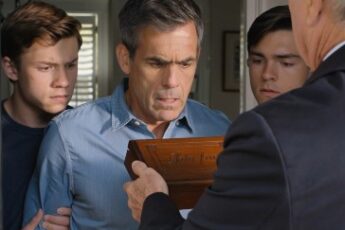
At his memorial, relatives filled the church basement with flowers, casseroles, and stories. I was carrying a box of his belongings when an elderly woman in a green coat stepped through the door.
She looked terrified.
“Are you Rachel?” she asked.
I nodded.
She placed a small brass key in my palm.
“Your father told me to give you this after he was gone.”
My uncle suddenly crossed the room.
“Elaine, you need to leave,” he said sharply.
She ignored him.
“There’s a house near Lake Erie,” she whispered. “It has been empty for eighteen years.”
My uncle reached for the key, but I closed my fist.
“What’s inside?” I asked.
Elaine’s eyes filled with tears.
“The proof that your father took the blame for something he never did.”
Then she looked directly at my uncle.
“And the man responsible is standing right behind you.”
👇👇 Part 2 in the comments 👇👇
PART 2
I turned slowly.
My uncle Martin stood beside the coffee table, his face pale.
For as long as I could remember, Martin had been the successful brother.
He owned a construction company, drove expensive cars, and always reminded everyone that Dad had wasted his potential.
Dad had worked maintenance jobs his entire life.
Martin had called him careless, weak, and irresponsible.
Now Elaine was staring at Martin as if she had waited eighteen years for this moment.
“What is she talking about?” I asked.
Martin forced a laugh.
“She’s confused. Your father felt sorry for her. That’s all.”
Elaine shook her head.
“No, Martin. That is not all.”
The room went quiet.
Elaine told me the house was in a small lakeside town forty minutes away. Dad had left written instructions that I should go there only after his death.
Martin stepped closer.
“Rachel, give me the key. Your father was sick. He wasn’t thinking clearly.”
“My father wasn’t sick,” I said. “He died in an accident.”
Martin looked away.
That was when I knew I had to see the house.
Elaine rode with me. Martin followed in his car, despite being told not to.
The property stood at the end of a narrow road surrounded by tall grass. It was a small blue house with boarded windows and a rusted mailbox.
The brass key opened the back door.
Inside, everything was covered in dust.
There was an old sofa, a wooden table, and dozens of sealed boxes stacked against one wall.
On the table sat an envelope with my name written in Dad’s handwriting.
My hands shook as I opened it.
Inside was a letter.
Dad explained that eighteen years earlier, he and Martin had jointly owned a home-renovation business. They had been hired to repair several apartment buildings for low-income families.
Martin had secretly replaced safe materials with cheaper ones and kept the extra money.
A fire later damaged one of the buildings.
No one was seriously hurt, but several families lost their homes.
Elaine had been the building manager.
She discovered invoices proving Martin’s fraud.
Before she could report him, Martin told Dad that exposing the truth would destroy the entire family business and send them both into bankruptcy.
Martin had a wife and two young children at the time.
Dad was single and raising me alone.
He agreed to sign a statement accepting full responsibility for the false invoices.
He lost his contractor’s license.
He lost his savings.
His reputation was ruined.
Martin kept the company and promised to support the displaced tenants.
But according to Dad’s letter, Martin broke that promise almost immediately.
Elaine lost her job and apartment after refusing to change her testimony.
Dad began paying her rent because he believed she had suffered for telling the truth.
“But why hide everything?” I asked.
Elaine sat at the dusty table.
“Your father was afraid that exposing Martin would hurt his children. He kept hoping Martin would confess on his own.”
Martin entered through the open door.
“That letter proves nothing,” he said.
Elaine walked to one of the boxes and removed a thick folder.
“This does.”
The folder contained original invoices, bank records, photographs, and a signed statement from the supplier Martin had bribed.
Dad had kept every document.
Martin’s confidence disappeared.
“You could have destroyed me years ago,” he whispered.
Elaine looked at him sadly.
“Daniel didn’t want to destroy you. He wanted you to become honest.”
I found another envelope beneath the folder.
It contained the deed to the blue house.
Dad had quietly purchased it years ago under a legal trust. He intended to renovate it and give it to Elaine, but he never had enough money to finish.
The letter said the house now belonged to me.
He asked me to make one choice.
I could sell it and walk away.
Or I could finish what he started.
Martin offered to buy the documents from me before we even left the room.
I refused.
I gave copies to an attorney and contacted the families affected by the old fire. The legal deadlines had passed for some claims, but the evidence was enough to expose Martin publicly and force a financial settlement through his company.
He resigned.
He sold his lakefront home.
For the first time, people learned why my father had lost his career.
Not because he was dishonest.
Because he had sacrificed his name to protect his brother’s children.
I used my inheritance and part of the settlement to repair the blue house.
When it was finished, I handed Elaine the same brass key she had given me.
She began to cry.
“This belongs to you,” she said.
“No,” I replied. “My father bought it for you.”
Elaine moved in that spring.
Above the front door, we placed a small wooden sign.
It read:
Daniel’s House — The Truth Always Finds Its Way Home.