I CAME HOME TO FIND MY HUSBAND DESTROYING MY LATE FATHER’S MUSIC ROOM—THEN I HEARD WHY HE NEEDED THE HOUSE SOLD BY FRIDAY
I knew something was wrong before I turned on the hallway light.
My husband’s keys were missing from their hook.
A strip of dark green wallpaper lay inside the trash can.
My father had painted tiny gold notes across that wall by hand during the final winter of his life.
Then I heard my mother-in-law’s voice from the den.
“Pull harder, Owen. Buyers hate sentimental clutter.”
I stepped closer without making a sound.
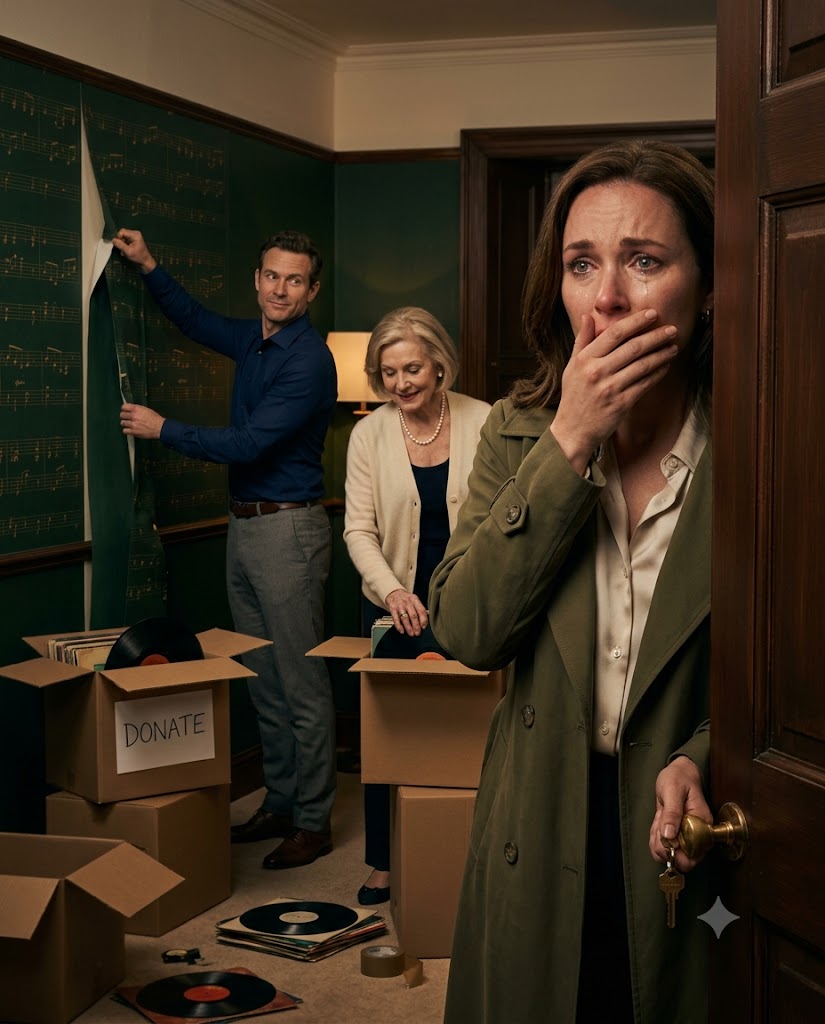
Through the half-open door, I saw Owen peeling wallpaper from my father’s music room while his mother packed old records into cardboard boxes.
“This house will sell fast once we make it neutral,” she said. “Then you can clear Madison’s debts and put the rest toward my condo.”
Madison was Owen’s younger sister.
She had spent years borrowing money and blaming everyone else when it disappeared.
Owen laughed quietly.
“Laura will be upset, but she’ll sign. She still thinks she can’t manage without me.”
My hands went cold.
The house was mine. My father had left it to me before Owen and I married.
They were planning to sell it without even asking.
I quietly removed Owen’s spare key from the hook and left.
That night, I called the attorney who had handled my father’s estate.
“Laura,” he said after checking the records, “your husband cannot sell the house.”
“I know.”
“But there is something else you need to see.”
He emailed me a document Owen had filed three weeks earlier.
At the bottom was a copy of my signature.
And above it were the words:
Authorization to transfer ownership.
👇👇 Part 2 in the comments 👇👇
PART 2
I enlarged the document on my laptop.
The signature looked convincing.
But it was not mine.
Owen had copied it from an old insurance form.
I called my attorney again.
“What exactly did he try to transfer?”
“Your house into a family trust,” he said. “The proposed trustees are Owen and his mother.”
My stomach tightened.
“If it had gone through, what would that mean?”
“They could attempt to control a sale. Fortunately, the filing was rejected because it lacked proper notarization.”
Owen did not know it had failed.
That explained why he and his mother were already preparing the house for buyers.
They believed everything was ready.
I did not confront them that night.
Instead, I photographed every damaged wall, packed box, and removed item.
Then I checked our shared finances.
The truth was worse than I expected.
Owen had taken out two personal loans without telling me.
He had sent nearly $38,000 to Madison over eighteen months.
There were payments to collection agencies, a luxury furniture store, and a company that rented office space.
Madison had secretly opened a beauty studio.
It closed after four months.
Now she owed suppliers, her landlord, and several clients who had paid deposits for services they never received.
Owen had promised to rescue her.
With my house.
I stayed at a hotel that night.
The next morning, I met with my attorney and changed the locks.
Then I contacted a restoration specialist to inspect my father’s music room.
The painted wallpaper could be repaired, but it would take time.
When Owen came home that evening, he found four suitcases on the porch.
He called me immediately.
“Why doesn’t my key work?”
“Because you tried to take my home.”
There was a long silence.
Then his voice became soft.
“Laura, come outside. Let me explain.”
“I already know about the trust.”
Another silence.
“My mother’s idea was only temporary,” he said. “We needed access to the equity.”
“You forged my signature.”
“I copied it because you were working late and the deadline was close.”
“That is still forgery.”
“We were going to pay everything back after Madison reopened somewhere smaller.”
I almost laughed.
“With what money?”
“She has talent.”
“She also has debts.”
Owen’s tone changed.
“You have a paid-off house and a good salary. You’re acting like we wanted to leave you homeless.”
“You wanted to sell the only home my father left me.”
“We would have bought another place.”
“A smaller one?”
He did not answer.
I already knew.
Inside a folder on his desk, I had found a rental listing for a one-bedroom apartment.
The house sale money was meant for Madison’s debts and his mother’s condo deposit.
There was almost nothing set aside for us.
“You planned to move me into a rental while your family divided my inheritance,” I said.
“You’re twisting it.”
“No. I finally understand it.”
His mother began shouting from behind him.
“That house has trapped you both in the past! A wife should help her husband’s family!”
I looked through the front window.
She stood on my porch wearing my father’s old wool cardigan.
She must have taken it from the music room.
“Take off that sweater,” I said.
“What?”
“It belonged to my father.”
She glanced down.
“It was in a donation box.”
“You created the donation box.”
Owen lowered his voice.
“Laura, please don’t make this uglier than it needs to be.”
“You already did.”
I ended the call.
My attorney filed for divorce the next morning.
We also reported the forged document.
Because the transfer had never been completed, Owen and his mother had no legal claim to the house.
The personal loans remained Owen’s responsibility because the money had gone directly to Madison’s business and personal debts.
Madison was furious.
She sent messages saying I had destroyed her chance to rebuild her life.
I replied once.
“Your future was never mine to finance.”
Then I blocked her.
Owen tried apologizing several times.
At first, he said he had only wanted to help his sister.
Later, he admitted something more honest.
He had spent years feeling embarrassed that the house belonged to me.
His name was not on the deed.
My income was higher.
My father’s work filled every room.
Selling the house would have made Owen feel powerful.
“I wanted one thing in our marriage to come from me,” he said during mediation.
“So you tried to take something that came from my father?”
He looked down.
That was the moment I knew there was nothing left to repair between us.
The divorce took eight months.
Owen moved into his mother’s condo rental.
Madison declared bankruptcy and found work at a salon owned by someone else.
My house stayed mine.
The restoration specialist repaired the music room carefully.
She saved most of the green wallpaper and repainted the missing gold notes using photographs my father had taken.
One section could not be perfectly restored.
A thin line remained where Owen had torn the paper too deeply.
I considered covering it.
Instead, I framed the damaged area.
Below it, I placed a small plaque:
Some things survive because someone finally chooses to protect them.
A year later, I began teaching free piano lessons in that room on Saturday mornings.
Children filled the house with wrong notes, laughter, and endless questions.
The space no longer felt like a museum of grief.
It felt alive again.
One afternoon, a little boy pointed at the repaired wall.
“Why is that part different?”
I touched the faint line.
“Because it was damaged.”
“Why didn’t you replace all of it?”
“Because being repaired is not the same as being ruined.”
He seemed satisfied with that answer and returned to the piano.
So did I.