A Small-Town Librarian Stayed Late to Help a Frightened Teen—Two Weeks Later, the Mayor Walked In Carrying a Sealed Folder 📚✉️
At 6:42 on a cold Thursday evening, fifty-eight-year-old Marjorie Ellis began turning off the lamps inside the public library in Chillicothe, Ohio.
The old building smelled of paper, floor polish, and the cinnamon tea she kept beside the checkout desk. One ceiling vent rattled whenever the heat came on.
Marjorie had worked there for nineteen years.
She lived alone in a modest apartment above a bakery and saved carefully for every expense. That month, she had postponed replacing her cracked reading glasses because her electric bill was higher than expected.
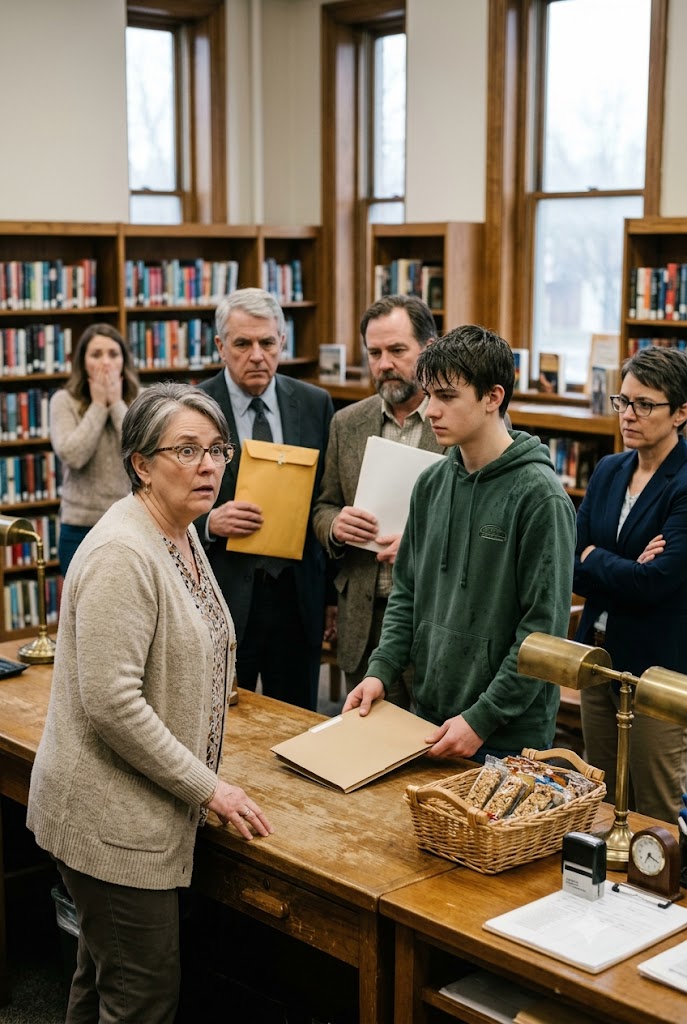
Still, she kept a small basket of granola bars beneath the desk for children who arrived after school without a snack.
As she reached for the front-door key, she noticed a teenage boy sitting behind the history shelves.
He wore a damp green hoodie and held a worn backpack against his chest. A broken zipper had been tied shut with a shoelace.
“The library’s closing,” Marjorie said gently. “Is someone coming for you?”
The boy looked toward the dark windows.
“My aunt was supposed to pick me up.”
“What’s her name?”
“Carla. She works at the nursing home.”
He checked an old phone with a nearly empty battery.
“She hasn’t answered.”
Marjorie introduced herself and asked his name.
“Evan.”
The branch manager, Paul Turner, emerged from his office wearing his coat.
“Marjorie, lock up,” he said. “The cleaning crew is waiting.”
“She’s probably still at work,” Marjorie told him. “He shouldn’t wait outside alone.”
Paul glanced at the clock.
“This isn’t a shelter. His family needs to handle it.”
Evan lowered his head.
Marjorie noticed a folded school form sticking from his backpack. The top corner had been softened by rain.
“Do you live nearby?” she asked.
“About four miles.”
“There’s no evening bus out that way,” Paul said. “Call the non-emergency number and let someone else deal with it.”
Evan’s face tightened.
“My aunt could lose her job if she leaves early again.”
Marjorie remembered how embarrassed her own son had felt years earlier when the family car failed and he had waited outside school until dark.
She looked at Paul.
“I’ll stay until his aunt gets here.”
“You’re already over your hours,” he replied. “The city won’t approve overtime.”
“I’m not asking for overtime.”
Paul shook his head.
“You keep turning every small problem into your responsibility, and one day it’s going to put this branch in trouble.”
He left through the side entrance.
Marjorie relocked the front door, turned one lamp back on, and made Evan a cup of hot chocolate from the staff-room packet.
He slowly opened his backpack.
Inside were several library books and a cardboard folder containing an application for a regional science program.
“The form’s due tomorrow,” he said. “My teacher said I need a computer.”
The library computers had already shut down automatically.
Marjorie restarted one terminal and helped him sign in.
For the next hour, Evan typed while Marjorie corrected spelling only when he asked. His project described a low-cost sensor that could alert families when a basement began flooding.
“My aunt’s basement flooded last spring,” he explained. “She lost almost everything stored down there.”
At 8:11, Carla finally called.
Her voice shook with exhaustion.
“I’m so sorry. A coworker didn’t come in, and my supervisor wouldn’t let me leave.”
Marjorie offered to drive Evan home.
Her old sedan had less than a quarter tank of gas, and the money in her purse was meant for groceries.
But freezing rain had begun coating the sidewalk.
She printed Evan’s application, placed it inside a clean folder, and drove him home.
Carla stood beneath the porch light in dark nursing-home scrubs.
“I can pay you for gas on Monday,” she said.
“No need,” Marjorie replied. “Just make sure he submits that folder.”
The next morning, Paul called Marjorie into his office.
A formal notice lay on his desk.
“You reopened a city computer after hours and transported a minor in your personal vehicle,” he said.
“He had permission from his guardian.”
“That isn’t the point.”
Marjorie folded her hands.
“What happens now?”
“I’m documenting it. If the city reviews this branch, I won’t be able to protect you.”
The warning stayed in her personnel file.
For the next two weeks, Marjorie continued shelving books, helping seniors use the printer, and placing granola bars in the basket beneath her desk.
Evan did not return.
Then, on a Tuesday morning, Paul appeared beside the checkout desk.
“The mayor is here,” he said.
Marjorie looked up.
“Why?”
“He asked for you.”
Near the entrance stood the mayor, the director of the regional science program, and Carla.
Evan was beside them holding the same cardboard folder.
A sealed city envelope rested on top of it.
Paul crossed his arms.
“This had better not concern the after-hours incident.”
The mayor looked directly at Marjorie.
“It concerns exactly that.”
Evan stepped forward and placed the folder on the checkout desk.
Then the science director removed a second document from her briefcase and turned it facedown before Marjorie could read it.
And what happened next left everyone speechless… 😱
👉 Continued in the comments… 👇👇
A Small-Town Librarian Stayed Late to Help a Frightened Teen—Two Weeks Later, the Mayor Walked In Carrying a Sealed Folder
—
PART 2
Evan had been accepted into the regional science program.
His application was not merely complete. It had received the highest score in his county.
The program director explained that Evan’s flood sensor could be built from inexpensive household components and might help families who could not afford costly equipment.
Then Carla opened the cardboard folder.
Inside was the printed application Marjorie had helped Evan finish that night. Attached to it was the library computer log showing the exact time the terminal had been restarted.
The second document was a statement from Evan’s science teacher.
It confirmed that without access to the computer that evening, Evan would have missed the deadline.
The mayor placed the sealed envelope in front of Marjorie.
“This is not a disciplinary notice,” he said. “It is a commendation from the city council.”
Paul’s arms slowly dropped to his sides.
The mayor continued.
“The city reviewed the incident. The library’s policies were followed poorly that night—but not by Mrs. Ellis.”
He explained that the branch had no clear procedure for children stranded after closing.
Marjorie’s judgment had exposed that gap.
Paul looked at her.
“I thought you were creating a liability.”
“I was trying not to leave a child outside in freezing rain,” she replied.
He nodded.
“I should have stayed too.”
The science director then announced something else.
A local education foundation had approved funding for a new after-school study program at the library. The program needed a coordinator who understood both books and people.
Marjorie was offered the paid position.
It included regular afternoon hours, a modest salary increase, and a budget for snacks, transportation vouchers, and emergency contact support.
Evan smiled.
“You were the first person who treated my project like it mattered.”
Marjorie touched the cracked frame of her glasses.
“It mattered because you did.”
A Small-Town Librarian Stayed Late to Help a Frightened Teen—Two Weeks Later, the Mayor Walked In Carrying a Sealed Folder
Three months later, the library’s back reading room opened every weekday until seven.
Students worked at refurbished computers while volunteers helped with homework.
Paul personally stayed late twice a month.
He also removed Marjorie’s warning from her file and apologized in front of the staff.
Evan became the first student in the new program to present a completed project. His flood sensor earned a small scholarship for summer science classes.
On the wall beside the checkout desk, Marjorie placed a simple wooden frame.
Inside was the first page of Evan’s application, with all personal details covered.
Beneath it sat the old basket of granola bars, now filled every morning.
Real kindness is rarely convenient, and it often asks for something before offering anything in return. Sometimes the smallest decision to stay becomes the reason someone else can move forward. ❤️
Would you have kept the library open for Evan that night?
Share this story if you believe kindness, patience, and one extra hour can change a young person’s future.