A Hospital Janitor Gave His Lunch to a Stranded Father—One Week Later, an Attorney Arrived Carrying a Sealed Envelope 🥪🏥😱
At 6:40 each morning, fifty-eight-year-old Raymond Ellis pushed his cleaning cart through the quiet corridors of Lakeside Community Hospital in Holland, Michigan.
The wheels squeaked near the elevators, no matter how often he oiled them. His cart carried lemon-scented cleaner, folded cloths, and a small radio that played the local weather report at low volume.
Raymond had cleaned the hospital for eleven years.
His wages covered the rent on a one-bedroom apartment and the electric bill, but there was little left afterward. That month, he had been setting aside money for new waterproof boots before the first heavy snow.
Raymond brought the same lunch most days: turkey on wheat bread, an apple, and coffee in a scratched silver thermos.
Whenever someone looked lost, he stopped cleaning long enough to point out the correct elevator or walk them to the proper waiting room. He remembered how confusing hospitals could feel when families were frightened.
One Tuesday afternoon, Raymond noticed a man sitting alone near the closed cafeteria.
The man looked about forty. His brown work jacket was damp from the rain, and a small paper bag rested beside his boots.
He kept checking the vending machine and then counting the coins in his palm.
A hospital clerk passed him without stopping.
The man finally approached the cafeteria gate and asked whether any food was still available.
“We closed at two,” the cafeteria supervisor, Denise Parker, replied. “The vending machines are down the hall.”
“My card isn’t working,” he said quietly. “I’ve been here since last night.”
Denise glanced at the clock.
“That doesn’t change the closing time.”
The man stepped away without arguing.
Raymond noticed a folded child’s sweater sticking out of the paper bag. One sleeve had a faded yellow star sewn near the cuff.
“Someone upstairs?” Raymond asked.
“My daughter,” the man said. “She was transferred here yesterday. Her mother is driving down from Traverse City, but the roads are slow.”
His name was Owen Barrett. He worked repairing heating systems and had left a job site so quickly that he had forgotten his wallet.
“My phone payment keeps failing,” Owen explained. “I just need enough to get through another few hours.”
Raymond looked at the turkey sandwich inside his lunch bag.
He had skipped breakfast, and his shift would not end until four.
Still, he handed the bag to Owen.
“There’s coffee too,” Raymond said. “It’s not fancy, but it’s warm.”
Owen shook his head.
“I can’t take your whole lunch.”
“You can return the thermos before you leave.”
Denise watched from behind the cafeteria gate.
“Raymond, employees aren’t supposed to encourage people to camp in the hallway,” she said. “If he needs assistance, he should speak to social services.”
“He’s waiting for his child,” Raymond replied.
“He is not your responsibility,” Denise said coldly. “One day, this habit of ignoring boundaries is going to cost you.”
Raymond said nothing.
He sat beside Owen for five minutes while the man ate half the sandwich. Owen saved the other half and wrapped it carefully.
“For my daughter’s mother,” he explained. “She may arrive hungry too.”
Before Raymond returned to work, Owen held out the scratched thermos.
“Keep it until the coffee is gone,” Raymond said.
That evening, Owen found Raymond near the west elevators.
“My daughter is doing better,” he said. “Her mother made it safely. Thank you for treating me like I belonged here.”
Raymond accepted the empty thermos.
“No parent should have to worry about lunch while waiting for news about a child.”
Owen asked for Raymond’s last name.
Raymond pointed toward the badge clipped to his shirt, then continued mopping the floor.
By Friday, the incident had reached Raymond’s supervisor.
Denise reported that Raymond had abandoned his assigned area, shared personal food in a public corridor, and allowed a visitor to remain near the closed cafeteria.
His supervisor placed a written warning in his file.
“You’ve been spoken to about leaving your section,” she said. “Another complaint could affect your hours.”
Raymond signed the paper.
The following week, the hospital announced that several support positions might be reduced because of budget problems.
Raymond tried not to worry, but the warning made him vulnerable. Without full-time hours, he would struggle to cover rent.
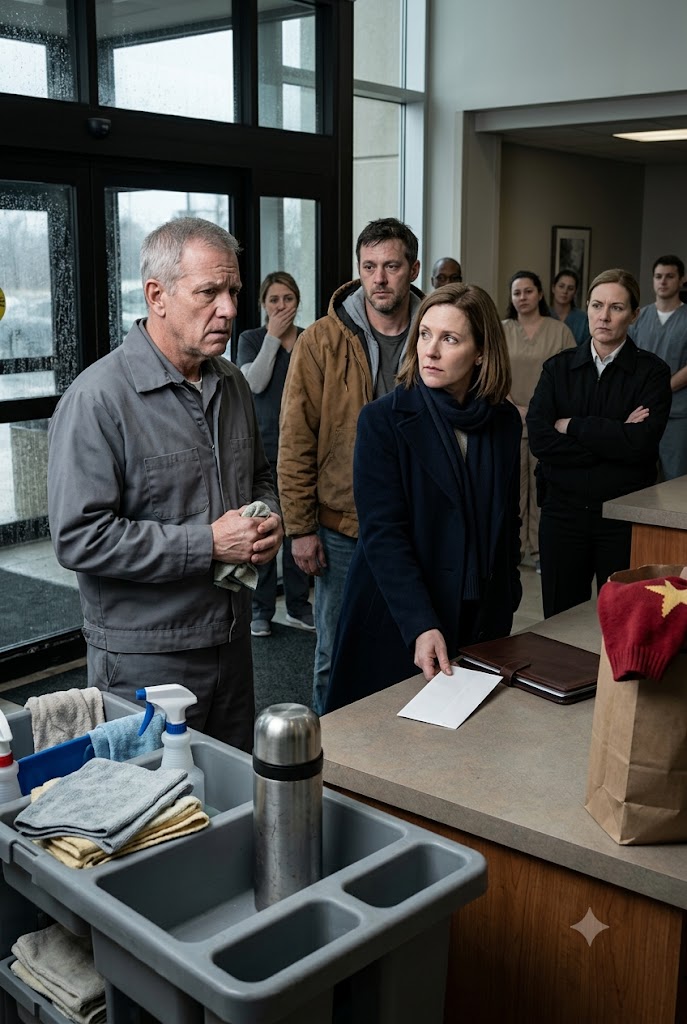
On Tuesday morning, exactly one week after meeting Owen, Raymond was polishing the floor near the main entrance when a woman in a dark coat walked through the doors.
She carried a sealed envelope and a leather document folder.
Owen followed behind her.
Denise emerged from the cafeteria and stopped when she saw them.
The woman asked the receptionist for Raymond Ellis.
When Raymond approached, she placed the sealed envelope on the counter but did not open it.
“My name is Claire Barrett,” she said. “Before this hospital decides whose job matters, there is something about last Tuesday that the administration needs to understand.”
And what happened next left everyone speechless… 😱
👉 Continued in the comments… 👇👇
A Hospital Janitor Gave His Lunch to a Stranded Father—One Week Later, an Attorney Arrived Carrying a Sealed Envelope
—
PART 2
Claire was Owen’s older sister and an attorney for a regional workers’ assistance organization.
She had not come to threaten the hospital or demand money.
She had come because Owen had told her that Raymond’s kindness prevented him from leaving the hospital at the worst possible moment.
Shortly after finishing the sandwich, Owen had received a call from his daughter’s care team. A consent form required a parent’s immediate attention, and Owen was still in the building because Raymond had helped him stay calm and remain nearby.
Claire opened her folder.
Inside was a hospital visitor log showing Owen’s arrival the previous evening and his continued presence through the afternoon. A time-stamped note from the patient-support desk confirmed that social services had been unavailable during the exact hour Denise told him to seek assistance.
Then Claire placed a second document on the counter.
It was a written recommendation from Owen’s employer.
Owen’s heating company had recently won the contract to service the hospital’s aging boilers. The owner needed a reliable on-site maintenance coordinator who already understood hospital routines and could communicate respectfully with worried families.
Owen had recommended Raymond.
“He noticed what everyone else ignored,” Owen said. “He gave up his own meal and never made me feel ashamed.”
The hospital administrator had already reviewed Raymond’s employment record.
For eleven years, he had arrived on time, received excellent safety evaluations, and helped visitors without a single formal complaint until Denise’s report.
The administrator removed the warning from Raymond’s file.
Denise lowered her eyes.
“I followed the policy too strictly,” she admitted. “Raymond, what I said was unfair. I’m sorry.”
Raymond stared at the offer in disbelief.
The new position came with steady hours, a modest raise, and paid training. It did not require him to leave the hospital community he had come to care about.
Owen gripped his shoulder.
“You gave me what you had,” he said. “This is not charity. You earned the chance.”
A few employees near the entrance began clapping. The receptionist wiped tears from her cheeks.
A Hospital Janitor Gave His Lunch to a Stranded Father—One Week Later, an Attorney Arrived Carrying a Sealed Envelope
Two months later, Raymond started each morning by checking the boiler rooms before walking the public corridors.
He finally bought the waterproof boots he had postponed, though he still carried the scratched silver thermos.
The hospital created a small cabinet near the family waiting area where employees could leave packaged snacks for visitors caught between meals. Denise quietly stocked it every Friday.
Owen’s daughter recovered and returned home.
Her faded sweater with the yellow star no longer sat inside a paper bag. Instead, a drawing she made for Raymond hung beside his work schedule, showing a smiling man holding a lunch bag beneath the words THANK YOU FOR HELPING MY DAD.
Raymond never expected his sandwich to change anything.
Real kindness is given because someone needs it, not because a reward is promised. Yet sometimes that kindness returns at the very moment the giver needs dignity, stability, and a door opened in return. ❤️
Would you have shared your only meal with a worried parent who had nowhere else to turn?
Share this story with someone who believes that compassion, fairness, and second chances still matter.