A Bus Driver Used His Work-Shoe Money to Help a Stranded Mother—Four Days Later, Two Officials Waited at the Depot 🚌☔
At 8:17 on a rainy Tuesday evening, sixty-two-year-old Harold Bennett pulled the last city bus into the nearly empty depot in Staunton, Virginia.
His knees ached after nine hours behind the wheel, and the sole of his right work shoe had begun separating again. A strip of black tape kept it together until payday.
Harold lived alone in a small duplex and carefully watched every dollar. He had placed forty-two dollars inside an envelope on his kitchen counter for a new pair of nonslip shoes.
Still, he always carried two wrapped granola bars in his lunch bag.
“Someone’s always hungrier than they look,” he often told the younger drivers.
That evening, rain tapped against the bus windows as Harold checked the seats for forgotten umbrellas and grocery bags.
Near the back, he found a small red mitten.
Then he heard a child crying beneath the depot awning.
A woman in pale blue medical scrubs stood beside a seven-year-old boy. Her sleeves were soaked, and she was pressing buttons on a phone with a cracked screen.
The boy held a cardboard model of the solar system beneath his jacket, trying to protect it from the rain.
Harold stepped closer.
“Everything all right?”
The woman looked embarrassed.
“My name’s Renee. My bus from the clinic was late, and we missed the connection to Waynesboro. My son has to present this project at school tomorrow.”
The depot attendant had already locked the ticket window.
Renee counted the money in her palm twice. She had enough for the morning bus, but not enough for a taxi home.
“I can pay the rest on Friday,” she told the taxi dispatcher over the phone. “I just started this job.”
The dispatcher apologized and ended the call.
Harold’s supervisor, Dale Mercer, came through the depot carrying a clipboard.
“The building closes in ten minutes,” Dale said. “They’ll need to make other arrangements.”
Renee lowered her eyes.
Harold noticed the boy’s wet sneakers and the carefully painted planets inside the damaged cardboard box.
“Is there anyone you can call?” Harold asked.
“My sister’s working overnight,” Renee replied. “There’s nobody else nearby.”
Dale glanced at the wall clock.
“Harold, clock out. Missing a bus doesn’t make this the company’s responsibility.”
Harold slowly removed his wallet.
The taxi fare was thirty-eight dollars.
He thought about the envelope on his kitchen counter and the shoe that would probably need another strip of tape by morning.
Then he handed the money to Renee.
“Get him home before that project turns into soup.”
Renee stared at the bills.
“No, sir. I can’t take your money.”
“You’re not taking it,” Harold said. “You’re borrowing a little peace of mind.”
Dale’s expression hardened.
“You keep making personal decisions on company time, and eventually they’re going to cost you this job.”
Harold said nothing.
He stayed with Renee and her son until the taxi arrived. He gave the boy the red mitten from the bus’s lost-and-found box so he could cover his cold hand.
Before leaving, Renee asked for Harold’s last name.
“You don’t need it,” he said.
“Yes, I do.”
“Bennett.”
She repeated it quietly, as though making sure she would remember.
The next morning, Harold reinforced his shoe with fresh tape and reported for his route at 5:45.
Dale placed a written warning inside his locker.
The notice said Harold had remained inside the depot after closing and had interfered in a customer’s private transportation problem.
His coworker, Marcus, read the paper and shook his head.
“You gave away your shoe money and got written up for it?”
“She had a kid standing in the rain.”
“That manager won’t care.”
Harold folded the warning and placed it inside his lunch bag.
For the next three days, nothing happened.
The loose sole grew worse. Harold walked carefully so passengers would not notice.
On Friday afternoon, Dale approached him while he was checking the wheelchair ramp.
“Bennett, come to the office.”
Harold wiped his hands on his faded gray jacket.
“Am I being suspended?”
Dale did not answer.
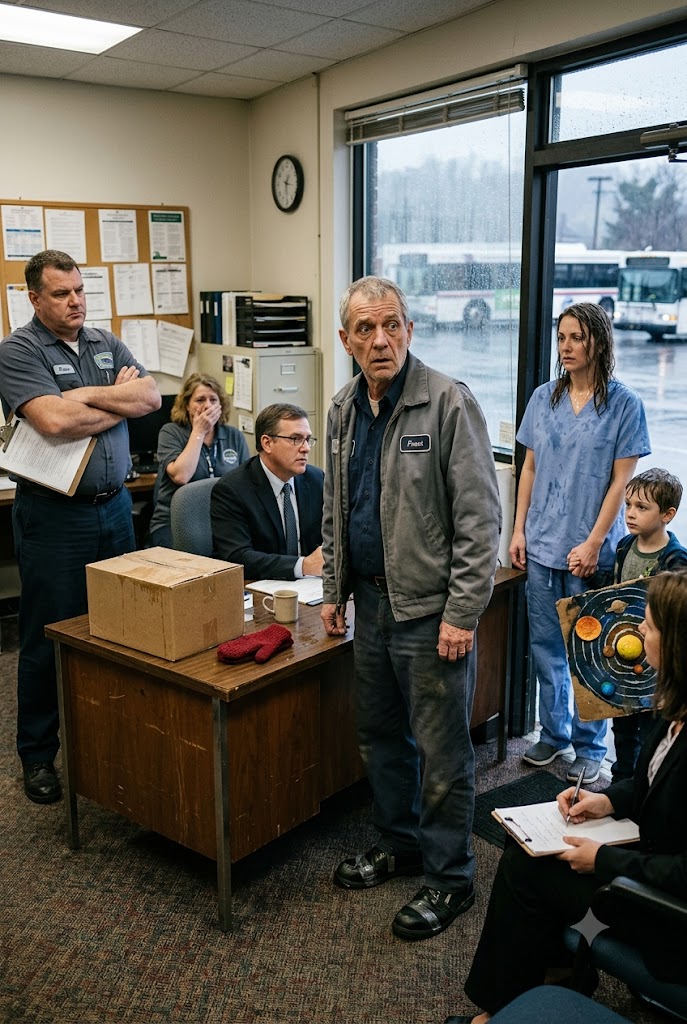
Inside the office sat the transit director and a representative from the city transportation committee.
A wet cardboard box rested on the desk.
Beside it lay a small red mitten.
Then the office door opened, and Renee walked in holding her son’s hand.
The boy carried a folded sheet of paper with Harold’s name written across the front.
Dale slowly lowered his clipboard.
And what happened next left everyone speechless… 😱
👉 Continued in the comments… 👇👇
A Bus Driver Used His Work-Shoe Money to Help a Stranded Mother—Four Days Later, Two Officials Waited at the Depot
—
PART 2
Renee had not returned simply to repay the taxi fare.
She worked as a medical assistant at a neighborhood clinic, and one of her patients happened to serve on the city transportation committee.
During an appointment, the patient noticed Renee’s exhausted expression and asked what had happened.
Renee told the whole story.
She also showed him the taxi receipt, which listed the exact pickup time outside the depot.
The committee representative then requested the depot’s security footage.
The video showed Harold standing beneath the awning in heavy rain, giving Renee the money and waiting until her son was safely inside the taxi.
It also recorded Dale ordering them to leave, even though the depot’s official closing time was still twelve minutes away.
The second surprise came from Renee’s son.
At school, he had written a short essay about a person who helped his family when everyone else walked past.
His teacher submitted it to a local kindness program without telling him.
The folded paper on the desk was the winning essay.
The boy looked at Harold and read the final sentence aloud.
“Mr. Bennett helped us because he saw people, not problems.”
Harold looked down at his taped shoe.
For several seconds, he could not speak.
The transit director removed Harold’s warning from the personnel file.
“You should never have been punished for treating a passenger with dignity,” she said.
Dale’s face turned red.
“I was trying to follow procedure.”
“Procedure didn’t require indifference,” the director replied.
Dale apologized to Harold and Renee. He was required to attend additional supervisor training, but Harold did not ask for him to be fired.
Then the committee representative explained the reward.
Harold was offered a permanent daytime route with regular hours and a small raise. He was also invited to train new drivers in passenger care.
Renee placed thirty-eight dollars on the desk.
Harold pushed it back.
“Use it for another school project.”
She smiled and handed him a separate box.
Inside was a sturdy pair of black work shoes. The clinic staff had collected enough to buy them after hearing the story.
A Bus Driver Used His Work-Shoe Money to Help a Stranded Mother—Four Days Later, Two Officials Waited at the Depot
Six weeks later, Harold began his new daytime route.
The hours allowed him to rest his knees, attend Sunday lunch with his brother, and volunteer twice a month at the community center.
Dale became quieter and more patient with passengers. One rainy evening, he used his own car to drive an elderly rider home after a route cancellation.
Harold never mentioned the old warning again.
Above the drivers’ time clock, the transit director placed the boy’s essay inside a simple wooden frame.
The small red mitten was pinned beneath it.
True kindness does not ask whether anyone is watching. Sometimes it returns when a good person needs help most. ❤️
Would you have spent your last shoe money to help that mother and child?
Share this story if you believe one compassionate decision can inspire an entire community.