A Retired Teacher Spent Her Grocery Money Helping a Struggling Student—Weeks Later, the Principal Called Her Onto the School Stage 📚✏️😱
At 9:15 each morning, sixty-seven-year-old Margaret Doyle unlocked the reading room at the small public library in Franklin, Tennessee.
The old wooden door gave a familiar groan, and the ceiling fan clicked every seventh turn. Margaret placed a jar of sharpened pencils beside the return desk and opened the curtains to let in the pale autumn light.
She had taught elementary school for thirty-two years before retiring.
Her pension covered the rent on her modest apartment, but rising grocery and electricity costs had made every month tighter. She kept a handwritten budget attached to her refrigerator with a strawberry-shaped magnet.
Margaret volunteered at the library four mornings a week.
She had a habit of leaving encouraging notes inside returned children’s books. Each note carried a simple message such as, “Keep going,” or, “This chapter is worth finishing.”
One Tuesday afternoon, a twelve-year-old boy entered the library carrying a flattened cardboard box.
His name was Ethan Cole. He had recently transferred to Franklin Middle School after his father found work at a local warehouse.
Ethan sat at a corner table and carefully removed several bent pieces of poster board, a small wooden bridge, and a plastic bag filled with loose craft sticks.
Margaret watched him try to press the bridge back together.
The structure collapsed again.
A group of students nearby packed their notebooks and left without speaking to him. One boy glanced at the broken project, then looked away.
Margaret approached the table.
“What are you building?” she asked.
“A bridge for science class,” Ethan said. “It has to hold twenty pounds by Friday.”
One side of his backpack had been repaired with gray tape. A cafeteria napkin was wrapped around his lunch as though he had saved it for later.
“My dad helped me start it,” Ethan explained. “But he works nights now, and some pieces broke on the bus.”
Margaret examined the project.
Several supports could be repaired, but Ethan needed stronger glue, fresh wood pieces, and a new presentation board. The library’s supply cabinet held only tape, paper clips, and dried-out markers.
Library coordinator Paula Grant noticed Margaret looking inside the cabinet.
“Those supplies are for library programs,” Paula said. “Personal school projects aren’t included.”
“He only needs a few things,” Margaret replied.
“Then his family needs to provide them,” Paula said. “This building cannot become responsible every time a student arrives unprepared.”
Ethan lowered his head.
“It’s okay,” he whispered. “I’ll tell my teacher it broke.”
Margaret noticed a small handwritten card beside the bridge.
On it, Ethan had listed every attempt that failed and what he had learned from each one. The last line read: TRY AGAIN WITH BETTER SUPPORT.
Margaret closed the cabinet.
“Pack the bridge carefully,” she told him. “There’s a craft store two blocks away.”
Ethan shook his head.
“I don’t have money.”
Margaret had thirty-six dollars in her purse.
That money was supposed to cover groceries until Monday. She had planned to buy chicken, oatmeal, coffee, and enough vegetables for several dinners.
She looked at Ethan’s taped backpack once more.
“Come with me,” she said.
At the craft store, Margaret bought wood strips, glue, a clean presentation board, and a small roll of blue paper. The total came to twenty-eight dollars and forty-three cents.
They returned to the library at 3:50.
Margaret’s volunteer shift had ended nearly an hour earlier, but she stayed beside Ethan as he rebuilt the bridge one support at a time.
“Don’t do it for me,” she said. “Show me what you think should happen next.”
By 5:20, the new bridge stood firmly on the table.
Ethan pressed both hands against the edge and smiled for the first time.
“My dad is going to be proud.”
“He should be,” Margaret replied. “You did the work.”
Paula stood near the closing desk with her coat over one arm.
“You kept the library open late for one child,” she said. “If the board hears about unauthorized tutoring, they may end your volunteer position.”
Margaret gathered the scraps from the table.
“Then they can speak to me.”
For the next three weeks, Ethan did not return.
Margaret wondered whether the bridge had survived the trip to school. She also stretched soup and toast through the weekend after spending most of her grocery money.
Then a formal message arrived from Franklin Middle School.
Margaret was asked to attend the fall student assembly on Friday morning. No reason was given.
Paula received a separate invitation from the school board.
“You involved the library in something without permission,” Paula said. “This may be a complaint.”
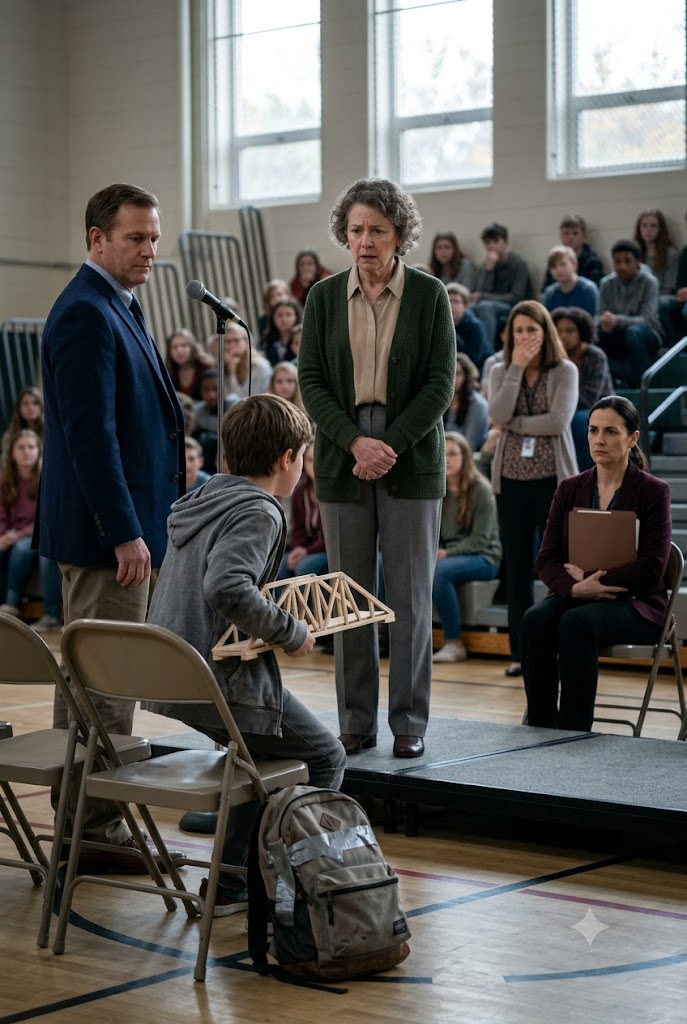
On Friday, Margaret sat in the back row of the school gym while hundreds of students filled the bleachers.
The principal stepped to the microphone and asked Margaret to come onto the stage.
Her hands turned cold.
Paula sat beside two library board members, holding a closed folder against her lap.
Margaret slowly walked forward.
Before the principal could explain, Ethan stood from the front row holding the repaired wooden bridge.
He faced Margaret, then turned toward the crowded gym.
“There’s something everyone needs to know about why this bridge is still standing,” he said.
And what happened next left everyone speechless… 😱
👉 Continued in the comments… 👇👇
A Retired Teacher Spent Her Grocery Money Helping a Struggling Student—Weeks Later, the Principal Called Her Onto the School Stage
—
PART 2
Ethan had entered the bridge in the school science fair.
It held forty-three pounds—more than twice the class requirement—and earned first place in his grade.
But the principal had not called Margaret forward because of the prize.
Ethan opened his school journal and read an entry written the night after their afternoon at the library.
“My project broke, and everyone thought I should give up,” he read. “Mrs. Doyle showed me that broken things need better support, not embarrassment.”
The principal then removed an official progress report from the folder Paula had been holding.
Before meeting Margaret, Ethan had missed six assignments and rarely spoke in class. During the following three weeks, he had completed every project and begun helping another new student during study period.
His science teacher confirmed the change in writing.
“Margaret did not build that bridge for him,” the principal said. “She gave him the patience to rebuild it himself.”
Ethan’s father stepped from the side of the gym in his faded warehouse jacket.
He held the craft-store receipt Margaret had left inside Ethan’s project bag.
“My son told me she spent money meant for her own groceries,” he said. “She never asked for it back.”
Margaret covered her mouth.
Several teachers wiped their eyes. Students rose from the bleachers and began applauding.
Paula looked down at the folder.
“The library board reviewed what happened,” she said. “Margaret should never have been threatened for helping a child. That was wrong, and I am sorry.”
The school had recently received local funding for a small after-school learning program.
The principal offered Margaret a paid position coordinating it three afternoons each week. The salary was modest, but it would ease her monthly bills and allow her to continue doing what she loved.
Ethan handed her the bridge.
“You told me it needed better support,” he said. “So did I.”
A Retired Teacher Spent Her Grocery Money Helping a Struggling Student—Weeks Later, the Principal Called Her Onto the School Stage
Two months later, Margaret supervised twelve students in the school library every Tuesday, Wednesday, and Thursday.
Some needed help with reading. Others needed a quiet table, a sharpened pencil, or an adult who would not make them feel ashamed for asking questions.
Paula created a library supply shelf stocked with donated poster board, notebooks, glue, and pencils. Families could take what their children needed without completing forms or explaining their circumstances.
Ethan visited Margaret every Friday.
The wooden bridge remained in a glass cabinet outside the school library. Beside it sat a small card bearing the words Ethan had written during his first failed attempts:
TRY AGAIN WITH BETTER SUPPORT.
Margaret’s life did not suddenly become easy. She still watched her budget and turned off unnecessary lights.
But her refrigerator no longer held only a grocery list beneath the strawberry magnet. It also held Ethan’s first-place ribbon and a note from his father thanking her for seeing his son when he felt invisible.
Kindness does not measure what it may receive in return. Sometimes it simply gives another person enough support to stand—and returns later when the giver needs support too. ❤️
Would you have spent money meant for your own groceries to help Ethan finish what he had started?
Share this story with someone who believes patience, dignity, and second chances can change a young life.