😱 A rich woman humiliated a young woman in a wheelchair by throwing red wine on her dress… but she had no idea who she was standing in front of. Minutes later, the entire gala fell into stunned silence.
PART 1
For a few seconds, nobody moved.
The crystal glasses stopped clinking. Conversations died in the air. Even the musicians near the corner seemed to forget the next note.
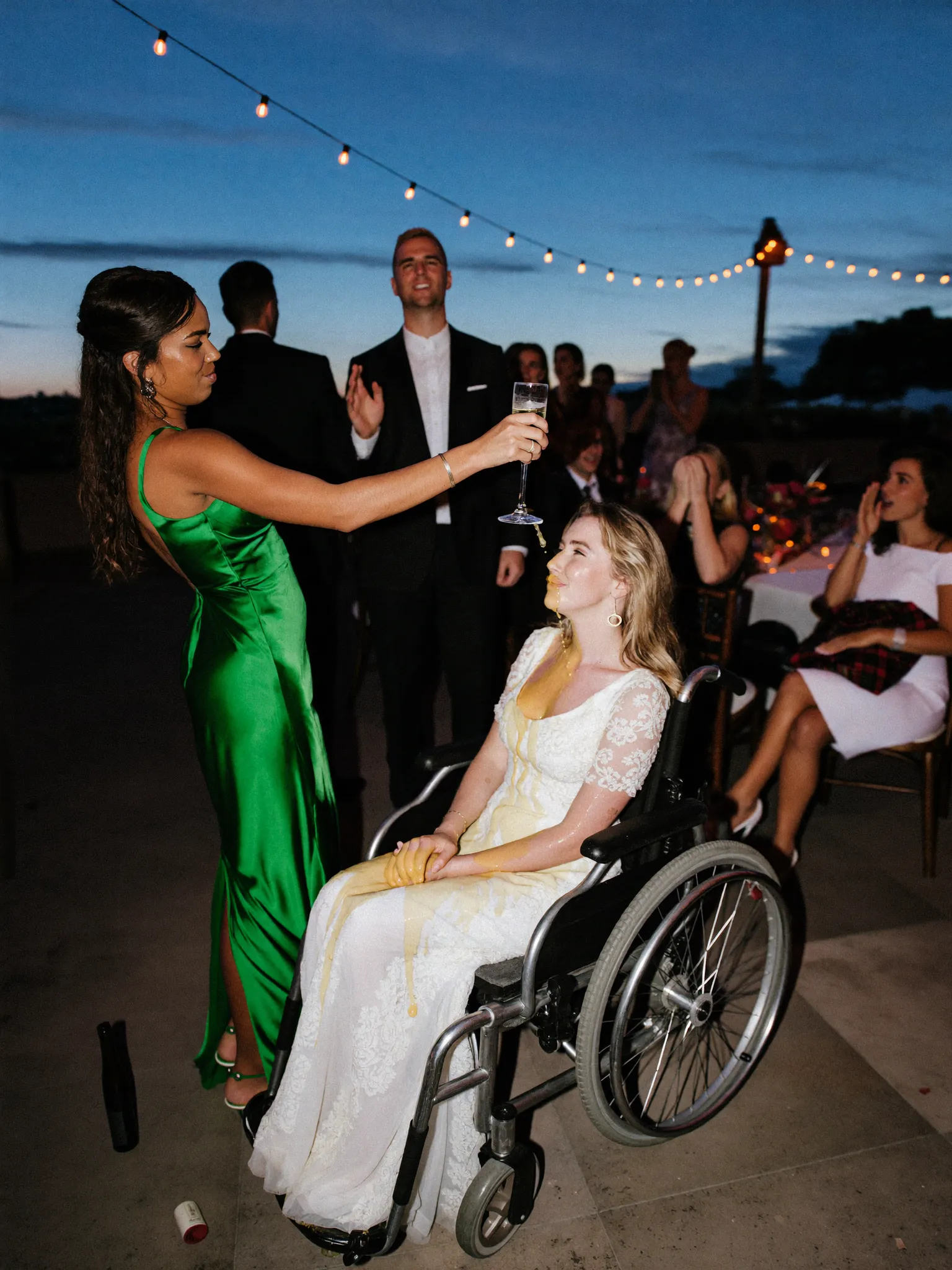
In the middle of the elegant charity gala, Giulia Romano stood with an empty wine glass in her hand.
Across from her sat Isabella Ferraro in a wheelchair.
The deep red wine had spilled across Isabella’s navy-blue evening gown, spreading like a wound over the expensive fabric. A few drops slid down onto the wheels of her chair. The room was full of wealthy guests, board members, donors, photographers, and journalists — but not one person immediately stepped forward.
They only stared.
Some looked embarrassed.
Some looked shocked.
Others looked away, pretending they had not seen what had just happened.
Giulia, dressed in diamonds and confidence, had poured the wine deliberately.
Not by accident.
Not in anger she could not control.
She had done it slowly, cruelly, with the same cold smile she used whenever she wanted someone to remember their place.
“Maybe next time,” Giulia said loudly enough for nearby guests to hear, “you’ll understand that not every event is meant for people like you.”
A few people gasped.
Isabella lowered her eyes for a moment.
Her hands tightened around the armrests of her wheelchair. The pain in her body was already difficult enough that evening, but humiliation had a different kind of weight. It settled on her shoulders, pressed against her chest, and tried to force her into silence.
But Isabella did not stay silent.
Slowly, with visible effort, she straightened her back.
That small movement cost her. Her legs trembled beneath the gown. A brief flash of pain crossed her face, but she lifted her chin anyway.
And somehow, sitting there in a stained dress, she looked stronger than every person standing above her.
Giulia’s smile began to fade.
There was something in Isabella’s eyes that she had not expected.
Not fear.
Not shame.
Not defeat.
Recognition.
Giulia swallowed.
“What?” she snapped. “Are you going to cry now?”
Isabella’s voice was quiet when she answered.
“No, Giulia. I finished crying years ago.”
The room changed.
People began turning toward them more carefully now. Some guests exchanged confused looks. Others leaned closer, suddenly sensing that this was no ordinary scene of cruelty between a powerful woman and someone she thought she could crush.
Giulia froze.
“How do you know my name like that?”
Isabella gave a small, sad smile.
“You really don’t remember me?”
Giulia’s face lost a little color.
For a moment, the arrogance slipped.
Then Isabella continued.
“Years ago, after my accident, my mother came to your foundation for help. She was desperate. The hospital bills were impossible. The therapy was expensive. We had nothing left. You looked her in the eyes and promised her that every donation raised in my name would be used to help me recover.”
A murmur moved through the room.
The foundation’s chairman, standing near the front table, slowly lowered his champagne glass.
Isabella looked around the hall.
“This gala exists because people believe they are giving money to children, families, and disabled patients who need help. People like I once was. People whose lives depend on someone keeping a promise.”
Giulia’s jaw tightened.
“I don’t know what story you’ve invented, but you should be very careful.”
“I was careful,” Isabella replied. “For years.”
Her hand moved to the small handbag resting on her lap.
Giulia’s eyes followed the movement.
Isabella pulled out a thick envelope.
The room became so quiet that the sound of paper sliding against paper seemed louder than the orchestra had been.
“I was careful when I started asking why my treatments suddenly stopped being covered. I was careful when I tried to understand why my mother had to sell nearly everything after donations had supposedly been raised for us. I was careful when numbers in old reports didn’t match. And I was very careful when I finally got access to documents no one wanted me to see.”
Giulia’s face turned pale.
“You’re lying.”
Isabella looked at her stained dress, then back at her.
“I wish I were.”
She wheeled herself closer to the board table and held out the envelope to the chairman.
“Read them.”
The chairman hesitated only a second before taking it.
He opened the envelope and pulled out the pages.
At first, his expression was professional. Calm. Controlled.
Then he turned to the next page.
And the next.
His face darkened.
His hand began to shake.
“My God…”
Those two words sent fear through the crowd.
Several board members rushed toward him.
“What is it?”
“Let me see.”
“Are these real?”
The pages moved from one set of hands to another.
And with each person who read them, the truth spread across the room like fire.
Fake invoices.
Hidden transfers.
Contracts with companies that barely existed.
Projects that had been announced publicly but had never truly helped anyone.
Donations collected in the name of sick children, disabled patients, and struggling families — money that had disappeared before it ever reached the people it was meant to save.
Everything was listed.
Dates.
Amounts.
Bank accounts.
Signatures.
Names.
Not rumors.
Not accusations.
Evidence.
Giulia took one step back.
Then another.
“No,” she whispered. “This is impossible.”
Isabella’s voice stayed calm.
“It is not impossible. It happened. For years, people came to this foundation with hope. Parents begged for help. Patients waited for treatment. Children were told money had not arrived yet. And while they waited, others used those donations to fund vacations, cars, jewelry, and homes they had no right to buy.”
The guests began looking at one another in horror.
Many of them had donated.
Some had hosted events.
Some had convinced friends and companies to contribute.
Now they were realizing that the charity they had proudly supported might have been built on stolen suffering.
A woman near the back started crying.
A man at the donors’ table whispered, “My company gave half a million last year…”
Giulia suddenly lifted her chin, trying to force the room back under her control.
“You are all being manipulated,” she said sharply. “These papers prove nothing about me personally. Nothing. Do you hear me? You cannot connect any of this directly to my name.”
For a second, Isabella said nothing.
Then a new voice came from the entrance of the hall.
Firm.
Clear.
Unshaken.
“Actually, Giulia, we can.”
Every head turned at once.
The doors at the back of the ballroom had opened.
A woman stepped inside, dressed in a simple black suit, followed by two financial investigators and several attorneys.
Giulia’s face collapsed the moment she saw her.
It was Alessandra Conti.
The foundation’s former Chief Financial Officer.
The woman who had disappeared from the organization two years earlier without explanation.
The woman Giulia clearly believed would never come back.
Alessandra stopped at the entrance and looked directly at her.
“You should have destroyed every copy,” she said. “But you forgot who taught me how to keep records.”
Giulia’s lips parted, but no words came out.
And in that moment, everyone in the room understood.
The woman in the wheelchair had not come to the gala to ask for pity.
She had come to expose the truth.
Read the rest in the first comment 👇👇
PART 2
The entire ballroom seemed frozen.
Alessandra Conti walked forward slowly, each step echoing across the polished floor. Behind her, the investigators carried folders. The attorneys looked serious, already focused on the board members gathered near the table.
Giulia did not move.
Only minutes earlier, she had been laughing, posing for photos, and speaking about compassion in front of donors.
Now she looked as if the walls were closing in around her.
Alessandra stopped beside Isabella.
For a brief second, the two women looked at each other. No long speech was needed. Isabella had brought the pain. Alessandra had brought the proof.
The chairman’s voice trembled.
“Alessandra… what is going on?”
She turned to him.
“What should have happened two years ago.”
Then she opened the folder in her hands.
“When I worked as Chief Financial Officer, I began noticing irregular payments. At first, they looked like administrative expenses. Then consulting fees. Then urgent transfers connected to programs that did not exist.”
Giulia suddenly snapped.
“She was fired for incompetence!”
Alessandra looked at her calmly.
“No, Giulia. I was pushed out because I started asking where the money was going.”
The guests erupted into whispers.
Journalists near the side of the room pulled out their phones. Photographers raised their cameras. Someone began recording.
Alessandra continued.
“Before I left, I made copies of everything I could legally preserve. Contracts. transfer records. internal emails. Board approvals. Shell companies. Payment requests. Reports that claimed thousands of people were helped — when in reality, many of those families never received a single cent.”
A board member turned white.
“Shell companies?”
“Yes,” Alessandra said. “Several of them. Created to receive funds through fake service agreements.”
Giulia shook her head violently.
“This is a setup. All of you are fools if you believe them.”
But her voice no longer carried power.
It sounded desperate.
Isabella looked at her quietly.
“You poured wine on me because you thought I was helpless. You looked at my wheelchair and saw weakness. But the truth is, I have been living with pain for years. I know how to endure. I know how to wait. And I know how to fight when something matters.”
The room fell silent again.
Isabella’s stained gown no longer looked humiliating.
It looked like evidence of Giulia’s cruelty.
The chairman handed the documents to one of the attorneys.
“This needs to be reviewed immediately.”
One of the investigators stepped forward.
“It already has been. We have been examining related records for several weeks. Miss Ferraro’s evidence and Ms. Conti’s testimony confirm the pattern.”
Giulia’s confidence finally cracked.
Her eyes darted around the room, searching for someone to defend her.
But no one did.
Not the donors.
Not the board.
Not the guests who had once praised her generosity.
Everyone was watching the same woman they had applauded moments earlier become the center of a scandal that was now impossible to hide.
Phones were out everywhere.
Messages were being sent.
Videos were spreading.
Within minutes, the story had already escaped the ballroom.
Giulia Romano, the celebrated face of a powerful charity foundation, had humiliated a disabled woman in public — only to be accused moments later of helping hide one of the foundation’s biggest financial betrayals.
And the young woman she had tried to shame was one of the very people the foundation had once promised to protect.
Giulia turned toward Isabella.
For the first time, there was no arrogance in her face.
Only fear.
“You don’t understand,” she said quietly. “These things are complicated. A foundation has expenses. People exaggerate. Money moves through many hands.”
Isabella’s expression did not change.
“No. What I understand is that my mother begged for help while you smiled for cameras. I understand that families were told to be patient while money vanished. I understand that children waited for treatment while reports claimed they had already been saved.”
Her voice trembled slightly, but she did not stop.
“And the worst part is not even the money. It is that I believed you. My mother believed you. We thought you were someone who cared.”
Giulia looked down.
For the first time that evening, she had no answer.
The gala ended in chaos.
Some guests left immediately, ashamed that they had supported the foundation without asking more questions. Others stayed behind to speak with investigators. Board members were separated and questioned. Journalists rushed outside, calling editors, sending footage, preparing headlines.
The next morning, the scandal was everywhere.
Not as gossip.
As a full investigation.
Over the following weeks, the truth grew darker.
Authorities found that large sums intended for medical programs and disability support had allegedly been redirected through outside companies. Several projects praised in public reports had never existed beyond paperwork. Some families listed as beneficiaries said they had never received help at all.
The more investigators uncovered, the more painful the story became.
There were children whose therapy had been delayed.
Patients whose equipment never arrived.
Parents who had spent nights begging strangers online for money while donations made in their children’s names sat in accounts they could not access.
Giulia was no longer the untouchable woman at the center of charity galas.
She became the symbol of everything people hate about false generosity.
Two months later, the investigation reached its first major conclusion.
Several foundation executives were summoned for legal proceedings.
Bank accounts were frozen.
Luxury assets were seized.
Financial records were turned over to prosecutors.
Families and programs harmed by the missing funds were identified, and compensation efforts were finally created.
But money could not erase what had happened.
The foundation’s reputation was shattered.
Donors felt betrayed.
Beneficiaries felt used.
And the public demanded answers about how so many warning signs had been ignored for so long.
The entire organization was restructured.
New oversight rules were put in place.
Independent audits became mandatory.
Board members who had failed to act resigned.
And then, in a decision no one at that first gala could have imagined, Isabella Ferraro was asked to become the foundation’s new Executive Director.
The same woman Giulia had tried to humiliate.
The same woman many guests had first noticed only because wine had been poured over her dress.
The same woman who had been treated as powerless.
Now she was the person trusted to rebuild everything.
When Isabella accepted the role, she did not do it for revenge.
She did it for every family who had waited too long.
For every child whose treatment had been delayed.
For every disabled person who had been photographed for fundraising campaigns but forgotten afterward.
And for her mother, who had once believed a promise that was broken.
Months later, Isabella returned to the same ballroom for the foundation’s first public event under its new leadership.
This time, there were no fake speeches.
No empty smiles.
No hidden accounts behind polished words.
Every donation was tracked. Every program was transparent. Every family helped was real.
At the end of the evening, a journalist approached Isabella and asked how she felt looking back on the night Giulia poured wine on her.
Isabella looked down for a moment.
Then she smiled softly.
“That night, she thought she was staining my dress,” she said. “But all she really did was reveal the stain that had been hiding inside this foundation for years.”
The journalist asked if she believed justice had finally arrived.
Isabella looked across the room at the families now receiving the help they had once been denied.
Then she answered:
“Justice does not always come quickly. Sometimes it arrives slowly, painfully, after years of silence. But when the truth is strong enough, it always finds the door.”
And this time, everyone in the room stood to applaud the woman they should never have underestimated.